

Creating Guiding Questions
Building directly on the habits established in the science notebook workshop, this session empowers teachers to design three distinct levels of guiding questions, Factual, Conceptual, and Debatable, aligned with Webb’s Depth of Knowledge. Teachers will take a deep dive into their standards to uncover the fundamental concepts students need, giving them a clear roadmap to systematically navigate content, analyze evidence, and confidently discuss real-world science phenomena.
Key Takeaways:
Universal Application: Master a versatile, adaptable framework for question design that can be applied to any science content across your entire curriculum map.
NGSS Practice Mastery: Build teacher and student confidence in the Science & Engineering Practices by guiding students to construct explanations and engage in argument from evidence.
Enhanced Critical Thinking: Use Crosscutting Concepts alongside Webb's DOK to help students connect isolated facts and understand how scientific ideas fit together.
Series Connection: Integrates directly with Interactive Science Notebooks & Journals, allowing students to document their questions, answers, and evidence as a living record of their scientific journey.
Equip your teachers with a powerful framework that guides students from surface-level facts to high-level critical thinking!
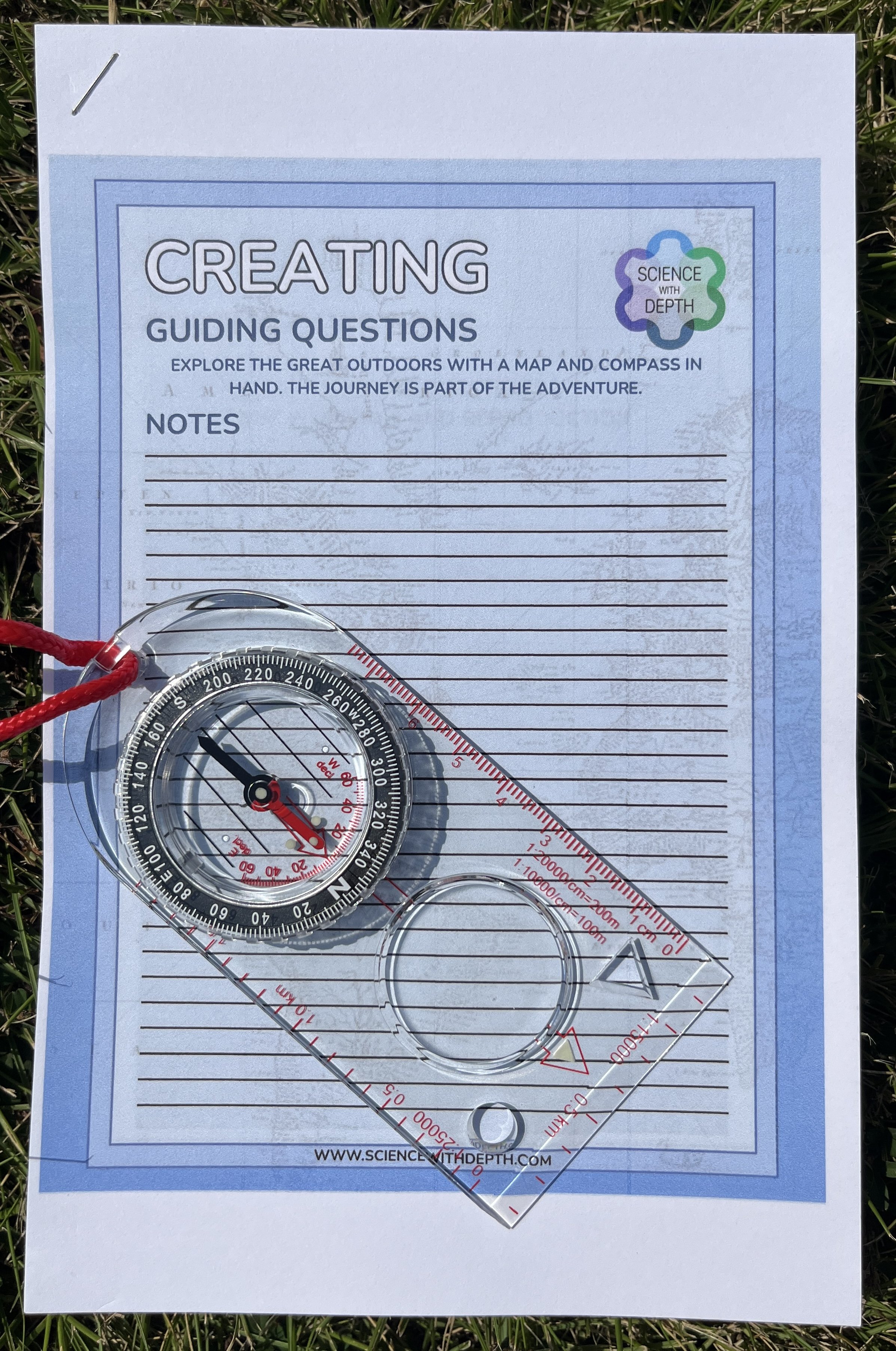
Tools that help you find your place in the world
Teachers will use the compass as a literal and metaphorical tool to generate questions that go from surface level facts to deeper applications. A compass is a versatile piece of equipment that can be used throughout the year in biology, ecology, astronomy, and Earth sciences. Once teachers understand its technical function, they will see the compass as a powerful metaphor for guiding questions. This is a strategy and takeaway that will transform your lessons from random observations to intentional explanations.